Bitcoin Difficulty Rises Again as Miners Recalculate Profitability
Bitcoin difficulty has climbed to 127.45T. See how the latest adjustment affects ASIC profitability, electricity costs, efficiency and mining ROI.

Bitcoin miners entered September with a little breathing room. That relief did not last long.
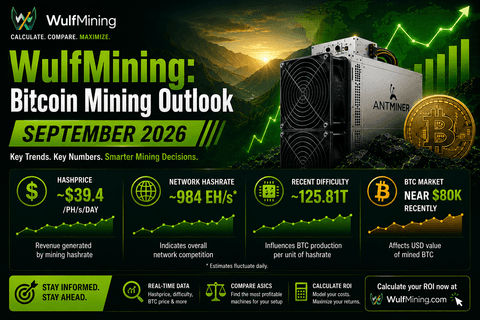
Bitcoin mining difficulty increased 1.31% on September 5, moving from approximately 125.81T to 127.45T. As of September 8, Bitcoin was trading around $79,300 on CoinWarz, while the next difficulty adjustment was provisionally estimated at another increase.
For miners, the message is straightforward: ASIC mining profitability needs to be recalculated whenever network conditions change.
A machine that looked attractive under 125.81T difficulty is now competing under slightly tougher conditions. That doesn’t automatically make it unprofitable, but electricity price and ASIC efficiency become even more important.
⛏️ Bitcoin Difficulty Is Back Above 127T
Bitcoin difficulty exists to keep average block production close to ten minutes even when network computing power changes.
The network recalculates difficulty every 2,016 blocks. When miners collectively produce blocks too quickly, difficulty can increase. When blocks arrive too slowly, it can decrease.

CoinWarz’s September 8 snapshot showed the network at 127.45T, with the next adjustment estimated around September 19. Its early projection pointed toward approximately 130.81T, or another 2.64% increase, but that estimate can change substantially before the actual retarget as block times and hashrate fluctuate.
Miners should therefore treat the projection as a scenario to prepare for, not a guaranteed outcome.
📈 Why Higher Difficulty Pressures ASIC Mining Profitability
Imagine your ASIC’s hashrate remains exactly the same.
It doesn’t suddenly become slower when difficulty increases.
Instead, the machine represents a smaller effective share of the competition for Bitcoin’s fixed block subsidy.
In simplified terms:
Higher difficulty → harder competition → less expected BTC per unit of hashrate
That’s why difficulty and profitability should be analyzed together.
The relationship becomes particularly important when margins are already narrow. A highly efficient ASIC with inexpensive electricity may comfortably absorb a small difficulty increase.
Older hardware running expensive electricity may not.
You can follow these changes using the
WulfMining Difficulty Tracker rather than relying on the profitability calculation you made when purchasing the machine.
⚡ Efficiency Is Your Defense Against Rising Difficulty
Consider two hypothetical Bitcoin ASICs producing exactly the same hashrate.

Both contribute 200 TH/s.
But Miner B consumes less than half as much electricity.
At $0.06/kWh, Miner A spends $7.20 per day on power while Miner B spends about $3.46. That’s approximately $3.74 per day of additional operating margin for the efficient machine.
Now increase network difficulty.
Both miners face pressure on expected BTC production, but Miner B begins from a much lower operating-cost base.
That’s why J/TH matters so much during difficult mining markets.
Efficiency determines how much electricity you need to purchase for each unit of computing power.
💡 Electricity Can Matter More Than a Small BTC Price Move
Electricity is the other variable miners can rarely afford to ignore.

The difference between $0.04 and $0.10 electricity is $5.04 per day per machine.
For a 100-machine operation, that’s $504 per day, assuming continuous operation.
Difficulty is the same for every Bitcoin miner. Electricity cost isn’t.
That is one reason two operators running identical ASICs can experience completely different profitability.
🌐 Hashrate Is Still Moving Sharply
Daily Bitcoin network hashrate estimates have also been volatile.
CoinWarz estimated approximately 1.13 ZH/s on September 6, followed by roughly 909 EH/s on September 7. Those daily estimates shouldn’t be interpreted as machines literally appearing and disappearing at precisely those levels; shorter measurement windows can fluctuate because hashrate itself is inferred from block production.
The bigger point is that Bitcoin remains an intensely competitive mining network.
When sustained hashrate rises, difficulty eventually responds.
That creates a feedback loop:
Better mining economics → more hashrate → faster blocks → higher difficulty → more pressure on miner margins
And that is why miners shouldn’t evaluate an ASIC from BTC price alone.
💰 Bitcoin Near $80K Helps, but It Doesn’t Solve Everything
Bitcoin’s price remains supportive compared with the weaker periods miners experienced earlier in 2026.
CoinWarz showed BTC around $79,306 on September 8, while Barron’s reported Bitcoin near $78,298 later in the day’s market action. The difference is a useful reminder that crypto prices vary by exchange and timestamp.
Higher BTC prices generally increase the dollar value of the Bitcoin an ASIC produces.
But profitability is ultimately a combination of several moving variables:
BTC price + difficulty + hashrate + transaction fees + pool fees + ASIC efficiency + electricity
A rising BTC price can offset a difficulty increase.
A sufficiently large difficulty increase can eat into some of the benefit of a higher BTC price.
And expensive electricity can undermine both.
🧮 Stop Treating Today’s ASIC Profit as a Fixed Number
Suppose a mining calculator shows an ASIC earning $10 per day after electricity.
It’s tempting to calculate:
$4,000 hardware cost ÷ $10/day = 400-day break-even
The arithmetic is correct.
The assumption isn’t.
That calculation assumes today’s revenue and costs continue for 400 days.
Bitcoin mining conditions will almost certainly change during that period.

The objective isn’t to predict the exact future.
It’s to understand how much deterioration your ASIC can withstand before it reaches break-even.
Use the WulfMining calculators to update your electricity and hardware assumptions, then compare the results with live network conditions.
🔍 A Better Weekly Routine for ASIC Miners
Rather than checking only whether Bitcoin went up or down, miners can build a simple profitability routine.
Start with BTC price. Then check Bitcoin difficulty and the next retarget trend. Review network hashrate and your ASIC’s actual pool performance. Confirm your effective electricity rate, including any additional hosting or operating charges. Finally, rerun profitability and ROI.
WulfMining brings several of those steps together through its Wulf miner database, calculators and difficulty tracker.
This turns profitability from a one-time estimate into an ongoing operating metric.
🎯 Conclusion
September is already demonstrating why ASIC miners need to watch more than Bitcoin’s price.
Bitcoin difficulty has moved from 125.81T to 127.45T, reversing some of the relief miners received in late August. The next retarget could increase competition further if current block-production conditions persist.
That doesn’t mean Bitcoin mining suddenly stopped working.
It means efficiency matters more when competition rises.
A miner with lower J/TH, cheaper electricity and enough operating margin has more room to absorb unfavorable network changes than an inefficient ASIC sitting close to break-even.
Don’t ask only:
“How profitable is this ASIC today?”
Ask:
“Will this ASIC still make sense if difficulty rises another 5%, 10% or 20%?”
That is the calculation that matters before committing capital.
Visit WulfMining and calculate your ROI now.
#Wulfmining #BitcoinMining #ASICMining #Asicminer